Women today make up 57 percent of urban runners and are even narrowing the gap in marathon participation, hitting around 45 percent of an average field. That’s a massive jump from a few years ago. So with those numbers in mind, it would seem obvious that the gear, apparel and shoes these female runners buy at run specialty stores would have some connection to women-owned businesses.
But that’s not necessarily the case, although progress has been made in recent years.
Women-owned/BIPOC-owned running brands, and women-specific running gear, remain a small piece of most running retailer’s inventory. The reasons are varied, as are the experiences of each brand, but the result is that many of them have turned to wholesalers and direct-to-consumer (DTC) models to make it.
“Whether women-owned or small brands, it has always been hard to break into this space,” explains Margo Cramer, owner of Oiselle. “It requires a big inventory commitment and upfront resources, something many start-ups don’t have.”
This is an issue Susan Clayton, the founder and owner of Baltimore-based WhitePaws RunMitts, understands very well. In her 10 years in business, Clayton has tried all avenues of selling, from DTC to wholesale to run specialty, ultimately finding the biggest success in wholesale.
“I got into REI in 2021 when the outdoors industry was doing a big push for diversity,” she tells Running Insight. “I started in their local, regional stores and today I’m in more than 100 of their northern locations.” She’s since expanded into spaces like Walmart and Amazon, too.
In contrast, when Clayton made a big push into run specialty a few years back, she got little traction. “I sent out sample mittens to about 100 different stores,” she recalls. “Out of the 100, five said they were interested, but none committed.”
Likewise, upstart Canadian-based women’s running shoe brand Hettas had big hopes for partnerships with run specialty stores. Instead, they experienced resistance and have pivoted to wholesale and DTC. “We wanted to form partnerships with run specialty to host events, bring in speakers and engage directly with customers,” says co-founder and CEO Lindsay Housman. “But there’s a knowledge gap about a women’s-specific shoe and the retailers need a proof of concept in order to take on a new brand.”
Hettas hasn’t thrown in the towel completely on running retailers, but it is now being extremely choosy about who it picks as partners. “We have a handful of stores in San Francisco and Vancouver that have been supportive and given us feedback so that we can do better in this space,” Housman adds. “Moving forward, we’ll be very transparent and make sure we have our values aligned.”
While women-owned brands struggle for space in run specialty, it’s that much harder for BIPOC-owned brands. “Women of color-owned brands are not making meaningful progress in retail spaces, including run specialty,” says Alison Mariella Desir, co-founder of Take the Lead, a running and outdoor industry retreat centered on the experience of women and femme of color. “Structural barriers still exist.”
This has been Clayton’s experience. “We know the BIPOC community has a hard time getting funding for start-ups,” she says. “I had to prove my concept first, whereas people who have the right connections and look the right way can get funding without proof of concept.”
Solutions Can Be Found
Despite the headwinds, a few women-owned brands have had success with run specialty. Oiselle has worked its way into more than 200 stores across the country and Cramer says that’s important for multiple reasons. “We are all digital natives now, but people are craving in-person experiences,” she says. “We want to offer women a cohesive experience with the brand and allow customers the chance to touch and feel our products.”
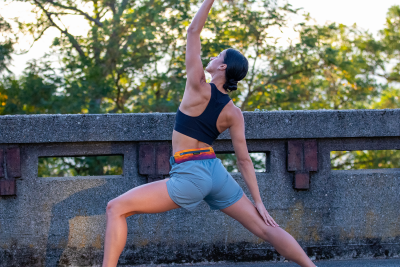
A prime success story can be found at Amphipod Running Gear, one of the first women-owned brands to break through into run specialty. June Angus, a co-founder and majority stakeholder, began by knocking on doors and she believes some of the brand’s success in run specialty ties into the fact that the market was much different 25 years ago.
“Back then, store owners were closer to the ground on what their customers wanted and made more decisions on what they purchased,” she explains. “Today, it’s more about limiting SKUs and vendors and cost effectiveness.”
Angus also believes there’s a difference between hard goods and soft goods in run specialty. “I’ve unfortunately seen it in buying meetings,” she says. “When you are in hard goods, the reality is that women are still undermined.”
Desir says she’s seen some progress in representation since beginning Take the Lead in 2022, but that progress is still limited at the executive level. “The most senior-level attendees at Take the Lead are typically at the manager/director level and we take that on as part of what we do to shift the industry,” she says. “We provide support and relationships needed to help women of color break through.”
Cramer says that Oiselle will continue to pursue local specialty stores with its products. “Smaller brands and women/BIPOC-owned brands aren’t given the opportunity to compete,” she says. “That’s not a criticism, but it’s reality. How do we partner with local specialty stores to make it easier for everyone?”
Desir says it’s essential that retailers devote time, energy and resources to intentionally create access and support to women-owned brands. “We’ve already seen an evolution of demand for new apparel, shoe and accessory brands over the last few years,” she says. “By providing retail distribution and local exposure to women of color-owned brands, retailers can invest directly in growing the industry while serving their communities.”
At the end of the day, women-owned and women-specific running brands are no longer emergent — they are here to stay. “The question is, have we solved the problems for women in sport?” asks Cramer. “We’re excited to give women more choices and we’re looking forward to creating meaningful community connection as a way to solve problems.”
.jpg.medium.800x800.jpg)