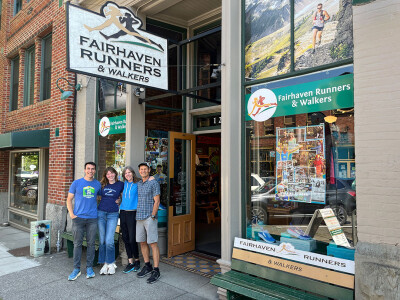
Steve Roguski knows a little about capturing long-term success in the run specialty retail game. In 1999, Roguski opened Fairhaven Runners & Walkers in Bellingham, WA. He and his wife, Genevie, owned the business for 25 years before “passing the baton” to longtime staffers Sierra Brisky and Dillon Quintana in August 2024.
From steady inventory control and financial stewardship to capable, connected staff and splashes of good fortune, Roguski understands various ingredients must coalesce to secure results in a competitive space – and even then, he acknowledges, there are no guarantees.
“Much has to come together for long-term businesses like ours,” Roguski allows.
Here, Roguski and other seasoned running retailers – Ross McDowell of Wisconsin-based Run Away Shoes, Alfred Olivetti of South Carolina’s Hilton Head Running Company and Jenni Peters of Varsity Sports in Louisiana – reflect on eight key factors that have helped them earn staying power in running retail.
1. Know your lane.
Olivetti, who opened Hilton Head Running Company in 2000, says “knowing who we are” has been critical to his shop’s 26-year run.
Hilton Head Island, for instance, hosts a large population of retirees and residents aged 60 and over are the island’s fastest-growing demographic. It’s no surprise then that the vast majority of Olivetti’s customers seek a comfortable shoe for daily life, not a 5K personal best. So, Olivetti has largely sat on the super shoe sidelines even if those models represent the market’s sexiest product.
“So much of that stuff would be lost on our market,” he says, adding the same rationale limits his investment in trail shoes. “Knowing our market and having a defined focus has helped us out the last 10-15 years, in particular.”
2. Adapt.
Since Peters opened her first Varsity Sports location in 2000 so much has changed – technology, marketing, products, e-commerce and so on. While retaining Varsity’s roots as a community-first brick-and-mortar store, she’s adapted in the face of rampant change around her. To meet contemporary expectations, she’s deployed a more intense focus on merchandising, operations, marketing and customer service.
“It’s been a lot of on-the-job education at the School of Hard Knocks, but we’ve learned a lot from those around us and continued to refine what we do,” Peters says.
Likewise, McDowell touts the importance of adaptability. Two years after opening Run Away in 2004, he had one retail storefront, $130,000 in sales, $13,000 in product and $120,000 in debt.
He didn’t stick with the status, quo but rather adapted and moved forward with strategic purpose. He opened a second store to increase volume, then a third location. He added events and timing and a T-shirt company to diversify operations. If something wasn’t working, McDowell analyzed potential solutions.
“When three stores proved too much, I got a buyer and moved on,” he says. “Shifting to two stores, then, gave me more flexibility to double down on what was working.”
3. Solid financial practices.
Running stores can undoubtedly be social, fun, festive, even wacky environments. When it comes to financial matters, however, diligence matters.
Roguski, for instance, prioritized living within his means at Fairhaven. From his “beautiful, just-big-enough historic building on Main Street” he recorded more than $2 million in annual sales. Rent for the 900-square-foot space was two percent of gross sales. He could’ve chased bigger, shinier, newer. He didn’t.
“Quite lucky for sure, but working toward a situation like this will go a long way toward business longevity,” he says.
Sticking on the fiscal management front, cultivating personal relationships with banks helps if the business needs a loan. Paying vendors on time drives more productive partnerships. And regularly analyzing expenses ensures a healthier bottom line. With sound financial practices, a running shop can better endure market fluctuations and the inevitable ebbs and flows of business.
“As local, regional or national downturns occurred, we had the financial strength, efficiencies and community support to be resilient,” Roguski says.
4. Slow and steady wins the retail race.
Much like distance running, Roguski says success in retail comes from putting one step in front of the other. Procedures, routines and systems reduce stress and drive consistency.
“Focus on being exceptional one customer at a time,” Roguski says. “Work to amaze the customer you are with – with enthusiasm, care and knowledge. Repeat. Repeat.”
Peters shares a similar sentiment.
“As we help one individual after another solve a problem, we gain trust and build relationships that feed our future,” Peters says.
5. Invest in your people.
Labor is certainly among the biggest challenges today’s running stores face. Assembling a quality group of people can help minimize that challenge – but it takes intentional investment.
At Fairhaven, Roguski honored the saying, “hire for personality, train for skill.” Then, he trained them, supported them and empowered them. He also created opportunities for staff to grow and apply their unique talents to the business.
Through the years, different staff members embraced opportunities to create new initiatives, programs or events at Fairhaven or tackled distinct sales, management or support areas of the business. This created “ownership” throughout the business, Roguski says, delivering longer-term employees with institutional knowledge and personal ties to the business – both of which contributed to Fairhaven’s viability.
6. Leverage the agency of others.
As Roguski recovered from surgery a few years back, he remembers feeling overwhelmed, stressed at how much was on his plate and wondering how he could juggle it all.
“Then, it dawned on me I could enlist our team to take leading roles in specific parts of the business,” he says.
Roguski assigned staff to lead particular areas of the business – “champions,” he called them. One directed the shop’s recycling program. Another was in charge of ordering shopping bags. Another oversaw IT issues. Another changed the air filters. He also began cross-training staff to ensure continuity and improve business resiliency.
“We can get locked into stasis and may need to remind ourselves that the feeling of being overwhelmed, for example, is something we likely brought on ourselves through previous choices or by thinking we need to do it all,” Roguski says.
7. Keep it fun.
It’s natural for business owners to stress about every detail, but that’s not a sustainable act long term. A running shop, in particular, should be fun. It’s largely a social, creative, active and positive environment. But don’t park fun on the bleachers, Olivetti suggests.
Hilton Head Running Company hosts about 40 events each year, most favoring the social over the serious. The Beach Bum Triathlon and Duathlon, for example, is a beachside event with a family-friendly vibe and low intimidation factor. The Scrap Iron 5K on a nearby remote island, meanwhile, pairs a 5K race with live music and drinks.
“We put a 5K on top of the party going on, which keeps it light for participants and us,” says Olivetti, who recorded his most profitable year at the running shop in 2025. “That helps us build goodwill and keeps our spirits high as a team, and those two things help keep us moving forward.”
The running retail business can be tough, McDowell acknowledges, but it’s important to avoid getting consumed by negative thoughts. That isn’t a recipe for healthy, long-term ownership, he reminds.
“It’s fun to be around the sport, promoting the sport and helping people, so remember to have fun,” he says.
8. Honor the golden rule.
At Fairhaven, Roguski made a concerted effort to maintain respectful relationships with customers, vendors, solicitors, neighbors, contractors and others with whom he interacted on behalf of the business.
“Reputation is a valuable asset and easy to lose, hard to recover,” he says. “Good works and good care of others have to come naturally and honestly, though. Otherwise, insincerity comes through and whatever you try to make happen will not be sustainable.”