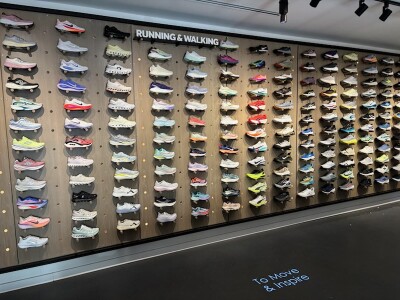
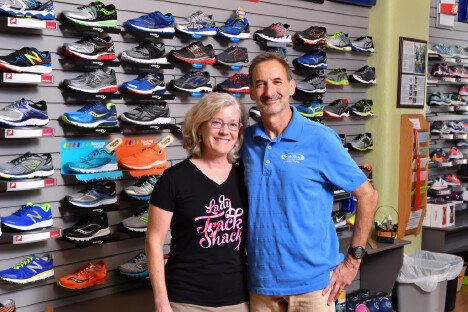
At St. Louis-based Running Niche, the composition of the eight-year-old store’s shoe wall prompts lively and regular conversation between owners Bob Dyer and Jennifer Henderson and buyer Sarah Trende. Rarely does a day pass without the trio discussing what models are moving and which ones are struggling to generate traction – and, perhaps more importantly, why.
“It’s a constant process,” Dyer says.
Curating the shoe wall has long been a challenge for running store leaders, who must balance space constraints, cash considerations, consumer interest and various other factors to create the appropriate mix of footwear models for their customer base. But in the golden age of running shoes, where compelling performance models from legacy brands and up-and-coming players are dropping at a rapid pace, assembling the shoe wall has become an even more difficult feat.
“The golden age of running footwear means so many options,” confirms Phil Kochik, owner of Seven Hills Running Shop in Seattle. “We want it all but can’t fit or afford it all.”
Market realities have pushed running retailers into deep reflection on the process and strategies determining which footwear models will inhabit the shoe wall – the most visible piece of real estate in their showrooms.
Here are seven factors some seasoned run specialty retailers are considering as they approach the shoe wall puzzle.
1. Leaning into the Nnumbers
Dyer, Henderson and Trende all regularly work the sales floor at Running Niche, which gives each individual firsthand insight into customer perspectives on footwear. They also query staff about their opinions on specific shoe models. That collective insight matters, but sales data plays an even bigger role.
“It’s easy to get sentimental about some models, but if we see shoes consistently at the bottom of our numbers, then it might not make sense to keep them,” Trende says.
Paul Curtis, shoe buyer for the two-store Runner’s Edge chain in Long Island, NY, employs a simple principle when curating the shoe wall: numbers don’t lie.
“Our shoe wall still has a healthy selection of road racing shoes for the traditional running club customer looking for a racing shoe for their next 5K or half marathon,” Curtis says. “However, detailed inventory and sales reporting tell us that maintaining a deeper inventory of the standard trainers in the $145-160 price range from each of our vendors is the best way forward for 2026 and into the front half of 2027.”
Tom Mansfield, president and chief operating officer at Baltimore-based Charm City Run, also leans heavily into data to inform footwear buying at the seven-store operation. He regularly reviews not only which brands are selling but the specific models proving to be most profitable.
“You’re going to be forced to make tough decisions, but the right data helps you take emotion out of it,” Mansfield says.
2. Seeking the right vendor artners
For new styles and brands, Kochik likes to start small and chase inventory with fill-in orders. Some brands, he says, make it easy to do this. Others, not so much.
“I’ve found if a brand doesn’t have enough inventory for us to do regular, small fill-in orders, it likely won’t work out at our shop,” he says.
Mansfield also cites brand behavior as a driving factor in the composition of Charm City’s shoe walls. Specifically, he favors brand partners who actively engage with store events, staff and customers and embrace a rising-tide-lifts-all-boats philosophy.
“We want partners who will drive traffic, give a meaningful presence in our stores and help amplify our brand,” he says.
3. A ‘fluid’ shoe wall
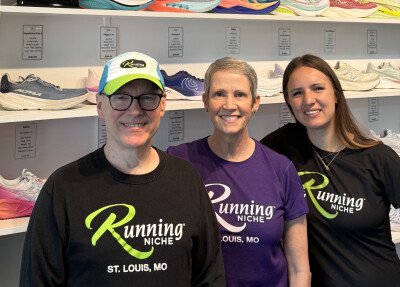
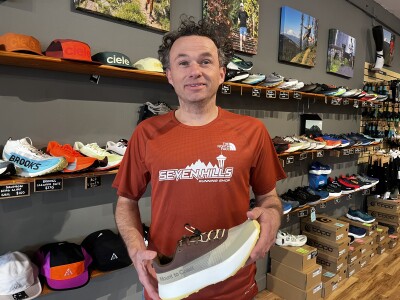
At Seven Hills, “nothing has permanent residency on the wall,” according to Kochik. Over the years, he’s moved off several styles that were once good sellers as well as newer models he was convinced would sell. He’s quick to cancel future orders if a particular model lingers too long and doesn’t hesitate to put a lightly selling model on sale to get it out the door. He doesn’t want languishing product, which limits his ability to purchase the styles and colors that are resonating with his customers.
“I like to think of the wall as fluid, not set in stone,” he says. “You have to be quick to adapt.”
Kochik calls the shoe wall “a competition for dollars” with customers largely dictating its composition in a given year.
“I have a plan to start but know it won’t go according to plan – a lot like a 100-mile race plan,” he jokes.
4. Knowing – and evolving with – customers
As the customer base at Runner’s Edge has changed, so, too, has the shoe wall.
Founded in 1985, Runner’s Edge made its name catering to competitive athletes and running enthusiasts. Today, however, the two-store chain’s customer base is far broader, including the fitness club crowd and referrals from healthcare providers like podiatrists and physical therapists.
To accommodate the swelling number of medical customers, for instance, the Runner’s Edge shoe wall now includes a deeper inventory of walking/running shoes with increased stability like the Mizuno Wave Horizon, Saucony Echelon and Brooks Beast.
5. Taking some calculated risks
Mansfield says it’s important to have “young, funky brands” splashed alongside the heritage brands representing the “meat and potatoes” of Charm City’s business. New brands generate curiosity and help ensure run specialty remains special.
Customers are also excited to see innovation, which, Mansfield reminds, can arrive from up-and-coming brands as well as established players. He cites Brooks’ Hyperion Collection as one notable example. Others point to Mizuno’s Wave Neo and Hyperwarp Collections and ASICS’ Metaspeed Series as innovative concoctions from legacy brands.
“It’s going to be a small part of our shoe wall, but we’re going to take some swings,” says Mansfield, who recently added Mount to Coast and Norda to Charm City’s shoe wall while also expanding the stores’ Puma inventory.
6. Riding the wave
In the early years at Seven Hills, Kochik optimistically assumed all his choices would be slam dunks. Over the years, however, he’s learned it’s tough to predict future sales. In fact, Kochik continues, the hottest models typically happen by surprise – and quickly reshape his shop’s footwear wall.
To wit, Kochik pre-booked a single size run of two Mount to Coast models, the R1 and T1, last spring. The T1 sold well and he immediately started scooping up more pairs. When he saw the H1 was dropping in late 2025, he pre-booked after only seeing a photo. It, too, sold well and Kochik quickly ordered more.
In 2026, Kochik is riding the hot hand, following a practice many run shops adopted in the earliest days of Hoka and On, in particular.
“This spring/summer we had seven pre-booked orders [with Mount to Coast], including two new models: C1 and M1,” Kochik says.
7. A reason for everything
At Running Niche, the “neutral, $150-ish” category best characterized by legacy models like the Brooks Ghost, Nike Pegasus and Mizuno Wave Rider features a wider selection of offerings because that category represents the meatiest part of the store’s business. In considering what to carry there, leadership puts greater emphasis on the shape and fit of the shoe so each model in the category fits a specific purpose.
Indeed, purpose defines the shoe wall at Running Niche. No style is on the display because it’s pretty or Dyer owes someone a favor. Every model has a specific reason for being there and the leadership team actively works to avoid redundancy, sometimes electing to invest in wide or narrow sizes of a top-selling model rather than bringing in a too-similar style.
“Sometimes, we need to pass on interesting models because we have current models already doing the job,” Dyer says. “We’ve done that many times and have no qualms about doing so.”
Adds Trende: “We need all of our shoes to fill a hole in the fit process. If a style doesn’t do that, then it’s tough to make it on our shoe wall.”
.jpg.medium.800x800.jpg)