Seven months ago, my husband was offered a job at the University of Tennessee at Chattanooga, a city I had never set foot in. Before we uprooted our family of four, I took a weekend to check it out.
Driving in from St. Louis, a friend I’d connected with on Instagram called with a suggestion: Get yourself to the Scenic City Run Crew’s one-year anniversary run at Fast Break Athletics. I drove straight there with minutes to spare — and walked into something beautiful. A big group of runners, brand tents, food trucks and a genuine cross-section of humanity gathered to celebrate a local run crew that had been building community and representation in this Tennessee city.
I ran with strangers who became friends, finished on the nearby trails that Fast Break owner Alan Outlaw pointed me toward and came back dazzled. We didn’t have trails like this in St Louis!
On my way back to the store, I spotted a group of people sitting in a pollinator garden within eyesight of Fast Break. Something told me to stop. I did, and many of those people have since become friends. They told me the store was a critical part of the neighborhood and they helped me understand the real weight of what I’d just witnessed — a run crew anniversary that meant something far beyond the miles.
That moment crystallized something I’d long believed but hadn’t fully seen in action — that specialty running stores can be the heart of a city’s running community. Not just a place to buy shoes, but a place to give back, to feel connected, to do something good for the place you live and love.
I am now a regular in Fast Break. I drop off used shoes that go directly to a local shelter. I stop in for a glass of water mid-run when I’ve underplanned. I buy shoes for my family and show up to Fast Break hosted events. Each of those touchpoints, I’d argue, is a sustainability initiative, and a model other stores can look to.
Fast Break is but one shining example. There are many others doing this work thoughtfully and well.
Sustainability In Action
A leader in this area is, of course, Palmetto Running Company, with two stores in Bluffton and Hilton Head Island, SC. Named the Best Running Store in America in 2023 by The Running Event, Palmetto Running Company has been weaving sustainability into every business decision for years.
Co-owners Rob Fyfe, Christian Fyfe and Keri Straughn (a true family business!) understand that most runners want to do their part, but aren’t sure where to start. Palmetto meets them where they are at, stocking responsibly made products and becoming a genuine pillar in the South Carolina communities they call home.
Their monthly trash pickup events and Care Comes Back program, which offers discounts to medical professionals, reflect a broader definition of sustainability: one that includes taking care of people and planet, two things that go hand in hand.
Another example of run specialty doing the work is
A Runner’s Mind, in Burlingame and San Francisco, CA. A Runner’s Mind has been putting in the work since 2015, earning recognition as one of the Best Running Stores in America nine times, including eight consecutive years.
Under the leadership of director of operations (and sustainability nerd like me) Nick Kovaleski, the store’s approach resonates deeply with my own style of activism: Bring people in rather than push them out. Guide runners gently toward better choices instead of shaming them for imperfection.
Beyond cutting operational waste, A Runner’s Mind functions as a community collection hub, accepting nutrition packages, pre-loved shoes, apparel and socks through a partnership with Sneaker Impact.
But my favorite initiative of ARM’s is the Trash Dash. In collaboration with Track and Feels, and inspired by local Instagram personality Mr. Bloom, they created participation medals for their plogging events. The twist: Those medals were made from cardboard shoe inserts embedded with local wildflower seeds. Runners love to receive something. A Runner’s Mind was innovative enough to make it something that gives back to the earth when you’re done with it.
Three More Sustainability Stars
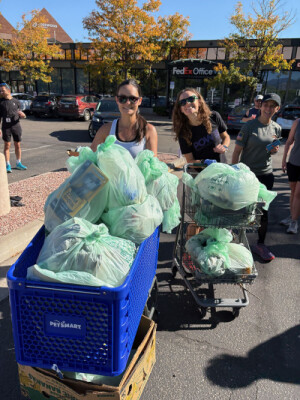
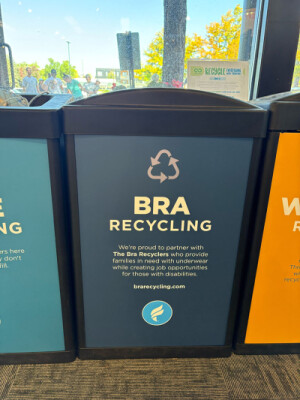
- Then there is Fleet Feet Boulder, in Boulder, CO. While hosting a plogging event at this store last September during Boulderthon weekend, I found myself genuinely geeking out over the collection infrastructure. Got Sneakers? bins for collecting worn shoes and Terracycle bins for gel and nutrition wrappers are bins I love to see.
- But it was their partnership with The Bra Recyclers that really caught my eye. The Bra Recyclers provide families in need with underwear while creating employment opportunities for people with disabilities. This is what a committed, multi-layered approach to in-store sustainability actually looks like.
- There is a lot of potential for specialty run stores as a community hub, and I believe sustainability can be the key to unlocking this.
- Back east at Tracksmith Trackhouse in Boston, sustainability isn’t only about environmental impact, it’s also about what you do for the broader running community.
Tracksmith has kept the upper floor of its Boston flagship, known as the Eliot Lounge, open as a gathering space for years. It’s where runners come to connect and learn about the history of the sport. My Boston book launch for Becoming a Sustainable Runner was held there and it remains one of my favorites for the intimacy the Eliot Lounge creates around conversations that matter.
Tracksmith’s products also reflect long-term thinking. Their use of Merino wool in many garments means fewer petroleum-based synthetics — better for the planet, better for your body and genuinely better at handling sweat and odor.
The brands a store chooses to carry is itself a sustainability statement and Duluth Running Company, in Duluth, MN, prioritizes brands like such as Hylo, Mount to Coast and Nnormal, companies that treat environmental impact as a core value, not an afterthought. By emphasizing environmentally conscious materials and ethical production, Duluth is making a quiet but meaningful choice every time they decide what goes on their shelves.
Run Specialty’s Role
I am an environmental activist and it probably wouldn’t surprise anyone that I am not a fan of the one-click purchase forces pushing independent retail out of the picture. But I’m also a realist, knowing that sweeping statements are the fastest way to lose an audience.
So here’s the one I’ll stand behind: Specialty running stores are among the most powerful levers we have for nudging runners toward a more sustainable relationship with the sport and the communities they run through. They are gathering places, drop-off hubs, event hosts, and trusted voices.
The best ones, especially my favorites described here, understand that sustainability is not a program you launch. It’s a choice you make, in every decision, every partnership, every event.
That’s not to say every decision can be or will be perfect, but just like the runners that these stores serve, what matters is that we take a step and work from there. That matters.
You likely have a running store that comes to mind for its potential in your city. How can you support them in becoming everything they could be?
_____________
Racing For Sustainability is always looking for environmentally curious runners to come join our network of runners. From opportunities to run the Abbott World Marathon Majors with RFS to finding like-minded people who are also doing their best, come join us at docs.google.com/forms/d/e/1FAIpQLSf4cK32DLCqta5fpympDmj-I0LAgOUGmXQn_MxeZwtYLwKN8w/viewform. The money raised by runners and brand support goes directly to financially supporting small to medium races transitioning to sustainable practices in their events. Race organizers can join Racing For Sustainability at runsignup.com/MemberOrg/RacingforSustainability and we can start supporting your goals.
.JPG.medium.800x800.jpg)
.jpg.medium.800x800.jpg)