Anyone in the running community or its periphery is almost guaranteed to have heard statements like “Running is for everyone! Just put on a pair of shoes and go!” But for many people, these statements and others like it ignore the very real barriers to enter into the sport.
While these sentiments may be well-meaning, they push diverse athletes and novices further to the margins. This disparity of participation exists across all running domains and only increases as distances grow and races get further from the road. Before we can consider correcting these disparities, we must understand why they exist. Why do we see these myths of equality and opportunity in running, ultrarunning, and trail running and for whom?
In her book “Running While Black,” Alison Mariella Désir details side by side the history of running Black people’s reality in the United States, demonstrating systemic barriers: longstanding, intentional obstacles built into the fabric of society which shape individuals and groups of peoples’ experiences and opportunities. Black Americans were excluded from many public parks, athletic clubs and recreational spaces; women were historically barred from participating in organized athletics and major races; and people with disabilities have long-encountered physical and structural barriers to participation.
Another important concept to understand is “intersectionality,” a theory by Kimberlé Crenshaw recognizing that race, gender, sexual orientation, class and other social demographics intertwine to shape a person’s experiences. When considered in the context of trail and ultrarunning communities, this means that a Black, trans woman, would face greater barriers to entry than a white woman.
Participation data tells the story in real time. According to the database produced by runrepeat.com, 69 percent of trail runners are white, 63.5 percent are men, and 31 percent make more than $100,000 annually. While trail and ultrarunning may not be exclusionary on paper, if communities, industries and races are not actively working against those systemic barriers, then they are upholding them.
Understanding the barriers
What are some of those barriers that organizations such as Women in Ultrarunning are working to overcome? Finances, safety, access to trails and outdoors, time, pregnancy-related experiences and inclusion policies are some of the most easily identifiable.
Recent data show that wealth inequality in the United States continues to grow. In 2020 Black women were on average paid 36 percent less than white men and 20 percent less than white women. A full 84 percent of women have experienced some form of harassment while on a run, 46 percent of women avoid parks or wooded areas due to fear of attack, and 72 percent of attacks have happened while running during daylight or “safe” hours.
Hate crimes for LGBTQ+ individuals have increased in recent years and race/ethnicity-related crimes make up more than 50 percent of hate crimes.
As a result, many people, especially low-income folks living in cities do not have access to safe running environments, let alone trails. Training for ultramarathons takes a lot of time, six-to-eight hours of training per week for six-to-eight weeks is often sighted as a minimum training dosage for a 50K.
Data also show us that women, especially in opposite-sex relationships, are more likely to take on additional roles within the home even when working outside of the home- meaning they have less time for leisure. Menstruation and pregnancy-related policies can also shape women’s and LGBTQ+ individuals’ abilities to participate in trail and ultrarunning.
Some ultramarathons entry systems are very competitive, requiring qualifiers and some luck to get on the start line. If a person is pregnant or gives birth, they may have to start this entry process from the start if inclusive policies are not in place, or if other races do not consider deferrals for adoptions, IVF treatments or miscarriages. Lastly, races that do not have trans or gender non-conforming (GNC) categories, runners quite literally must misgender themselves to even register for the race.
Enter Women in Ultrarunning
This is where the idea that running is simply for “everyone” falls short. If we want to understand why some communities remain underrepresented in trail and ultrarunning, then the question is not simply, How do we get more people to sign up? Perhaps the question to ask is: What stands between people and participation and what could the running community change to remove those barriers?
Women In Ultrarunning grew out of a contradiction founder Rachel Bambrick kept running into: If women are capable of running 50Ks, 100-milers and 200-mile races, sometimes winning them outright, why are they still so underrepresented at the start line?
While women’s participation has increased drastically in trail and ultramarathon running since the early 2000s, we still see women making up approximately 35 percent of trail race start lines and 25 percent of ultramarathon start lines. The percentages for transgender and gender non-conforming (GNC) individuals starting trail and ultramarathon races tends to be fewer than one percent.
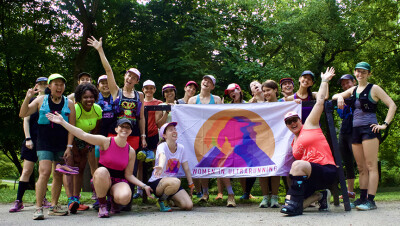
Women In Ultrarunning (WIU) started in 2024 as an event series local to Bambrick’s Philadelphia running community. It quickly grew into a global movement helping to empower more women to feel empowered within the sport of ultrarunning. With in-person chapters across the United States and a vibrant online community, virtual education workshops, and grant programming, WIU works to ensure all women feel like they have a place in the sport.
The barrier is not that women and trans/GNS folks need to be convinced they can run far. Ultrarunning can be intimidating to enter with a steep, largely unwritten learning curve. How do you fuel for 30 hours on your feet? What gear do you actually need? How do you pace through the night? What happens when your stomach stops cooperating at mile 70?
Much of that knowledge is passed through existing communities and relationships. If you don’t already know someone who runs ultras, you may not even know which questions to ask.
WIU is working to make that knowledge–and the community around it–easier to access. WIU has four chapters in Pennsylvania, Montana, Colorado and New Jersey where in-person events are held monthly to create community and provide each attendee with empowering knowledge about the sport of ultrarunning.
WIU also has a growing online community via the app Heylo. This online community allows members to find other trail and ultrarunners in their area, plan for races, chat about the best gear, share fun stories of adventure, absolutely spam the chat when watching Rachel Entrekin won Cocodona 250 outright and even a space to share some of the not-so-great things that can happen when pursuing big running goals, like injury or harassment. WIU also hosts regular virtual skill-building sessions to help the community feel more confident taking on these massive feats.
WIU has created scholarship funds to reduce some of the barriers to entry for women and trans/GNC folks getting to the start lines of races. Since their incorporation as a non-profit in 2025, they have awarded nearly $10,000 in grant funding to support female and gender nonconforming ultrarunners. Most recently, the Colorado chapter leader Katie Burns, ran the entirety of the Highline Canal, creating two grant opportunities for trans women in the sport.
The path into ultrarunning doesn’t begin at the start line or with an ultramarathon. For many runners, it begins much earlier, with questions of whether there is a place for them out on the trail at all.
You can see these more of these inclusive running communities popping up in the United States and across the globe. Let’s take a look at some of them:
• Women of the Wasatch (WoW) began in 2020 with a relatively simple premise: Make trail running more accessible to women and to create a sense of belonging. What started as a group of about 10 women grew to more than 650 members within the first two years and now encompasses more than 2000 members across seven Utah chapters along the Wasatch Front.
WoW’s growth points to a need that goes beyond simply finding people to run with. For many, getting onto the trail isn’t the hardest part. It’s knowing where to start, who to ask, what you need and whether there’s a place for you there. For WoW, community isn’t just something that happens alongside trail running — it’s part of how people find their way into the sport.
Part of WoW’s work is simply making showing up a little less scary. Group runs welcome a range of abilities, including a designated “party pace,” led by a volunteer chapter leader who keeps the group together at a conversational pace, with walking breaks welcome. WoW helps runners build the practical knowledge to navigate the trails, with workshops on gear, skill development and safety. Online, members can ask questions, share resources, find running partners, and stay connected outside of weekly group runs. The result is a community that can meet runners where they are and give them the confidence, connections, and know-how to keep showing up.
Community, however, is only one piece of the puzzle. WoW also supports runners pursuing trail and ultraracing, from someone eyeing their first ultra to an experienced runner chasing a podium finish. WoW’s annual Breaking Down the Barrier Scholarship recognizes that barriers to trail and ultrarunning don’t look the same for everyone, offering scholarships for BIPOC, LGBTQ+, disabled/adaptive and mom/caregiver athletes. Recipients receive shoes, gear, race entries and coaching, helping remove some of the financial and practical barriers to getting started and going further.
The Start Line Project, a collaboration between WoW and Speedgoat Mountain Races by UTMB, pairs direct race access with community and support needed to get women to the start line. This initiative combines race scholarships for five women with training runs, education, childcare support and race-weekend programming, all designed to increase the number of women at the start line of the Speedgoat 50K, acclaimed to be the hardest 50K in North America. WoW’s work illustrates that community, confidence, practical resources, and support networks can turn participation into a sense of belonging–and a reason to stay.
Toeing the start line is one thing. Getting there and finding that no one looks like you is another. The further you go, the harder those familiar faces can be to find. That can mean fewer visible role models for a newer runner figuring out how to enter the sport, and it can also mean fewer opportunities for accomplished BIPOC athletes to see themselves reflected in the broader ultrarunning community.
• We Run Long is working to change that by building a pathway into endurance sports for Black, Indigenous and people of color, particularly for runners who are newer to trail running or looking to progress into longer distances. Through initiatives such as Camp We Run Long, in collaboration with Altra Running, Freestone Endurance and Trail Mix Fund, the organization brings BIPOC runners together around the shared experience of trail and ultrarunning, while giving runners at different stages of their journey access to resources, connections, and community.
We Run Long selects a geographically diverse cohort of about 20 runners across ages and experience levels. In the months leading up to the race participants meet regularly, receive training plans, and have access to guidance, resources, and a network of fellow runners. The Camp itself is an all-inclusive race-weekend experience and covers ground transportation, lodging, meals, shoes and race entry to help offset some of the financial barriers that can make racing inaccessible. The support extends beyond race weekend, giving participants a community to draw on before, during and after the race.
The goal isn’t simply to put more diverse runners on a start line; it’s to make sure they aren’t arriving or leaving alone. Camp participants experience the race weekend alongside a cohort of BIPOC athletes. The relationships can become mentorship, training partners, pacing and crew networks, the kinds of social infrastructure that are often difficult to find when representation is thin. By making racing a shared experience rather than a one-time achievement, We Run Long can help turn a first race into a pathway for continued participation.
But creating pathways for individuals and groups of runners doesn’t necessarily change the structures they’re entering. What happens when races, brands, media and organizations surrounding the sport remain unchanged?
• Black Trail Runners (BTR), a UK-based nonprofit that combines community building with advocacy to increase participation, representation and visibility of Black people and People of Color in trail running. BTR recognized that you cannot meaningfully address representation if the sport doesn’t even know who is participating, doesn’t reflect those participants in its media and events and doesn’t create space for them in the first place.
BTR began by asking a deceptively simple question: Who is actually participating in trail running? When the organization began working with race organizers to collect ethnicity data in 2020, there was little information available beyond anecdotal experiences. The data revealed a significant representation gap: Black people make up about 4.5 percent of the UK population, but accounted for less than one percent of trail race entries. For BTR, identifying the gap was a starting point, not an end point.
Their response has operated at multiple levels. BTR creates opportunities for Black runners to participate through free community trail runs, trail-taster events and skills workshops, including transportation to help address the geographic and financial barriers to accessing trails.
They have also pushed against the visibility gap. A lack of representation in the media encouraged accomplished Black runners to deliberately show up at events, increasing the opportunities for Black runners to be represented in running media and making representation harder to overlook. And rather than waiting for the existing race calendar to become more representative, BTR created its own space with Black to the Trails, a trail running festival designed to be UK and Europe’s most ethnically diverse trail-running event.
Taken together, BTR’s work points to a different kind of intervention. Representation isn’t only about who participates; it’s about who gets counted, who gets seen and who gets to shape the sport. Diversifying the participants without changing the systems around them has limits. BTR demonstrates what it can look like to push for change not just on the trail, but in the institutions, events, media and decision-making structures surrounding it.
So far, we’ve demonstrated ways to make ultrarunning more accessible: How do we create belonging? How do we build pathways? How do we change the systems around participation? But there’s another question worth asking: What if inclusion isn’t simply about bringing more people into the existing culture of ultrarunning?
• Rising Hearts offers an example of what that can look like. Its Running on Native Lands Initiative works with race directors, brands and event organizers to go beyond land acknowledgements as a symbolic gesture and toward an ongoing relationship with Indigenous communities connected to the lands where races take place. That can mean connecting event organizers with local communities, bringing Indigenous voices into races and events and helping runners understand how to respectfully interact with the lands and ecosystems they move through, including recognizing that many of the places treated as public recreational spaces are Indigenous lands shaped by histories of Indigenous dispossession and displacement.
Rising Heart works both to increase Indigenous representation in trail running and to change how the running community understands its relationship to land, community and responsibility.
Welcoming more people into the sport doesn’t require everyone to experience it in the same way. It can mean allowing the sport to be shaped by the people it hopes to include, making room for different histories, relationships, values and ways of moving through the outdoors.
Taken together, these organizations make one thing clear: inclusion isn’t a single intervention. It can mean opening the door to a sport that feels difficult to enter, building the community that makes people want to stay, changing the systems that determine who gets opportunities or making space for communities to have a say in what the sport becomes. Those changes don’t belong to non-profit organizations alone. The people and institutions surrounding the sport make decisions every day that shape who sees a place for themselves, who has the opportunity to participate and what participation looks like once they arrive. Race directors, brands, retailers, media and athletes all have a role in shaping what comes next.
Race directors have perhaps the most immediate influence over that experience. Before a runner even reaches the start line, a race has already made decisions about registration, pricing, race categories, accessibility, pregnancy and childcare policies, and safety. During race weekend, those decisions extend to volunteer recruitment, staff and medical teams, and whose stories and achievements are highlighted. Small choices can determine whether a race feels like an invitation or an obstacle course of its own.Some very practical steps race directors can take to make their races more inclusive include 50/50 lottery policies, racing categories for trans/GNC competitors, working with local BIPoC and LGTBQ+ organizations, equal prize purses for winners, 50/50 start lines, menstrual hygiene products at aid stations, equal coverage of men and women’s elite races, clear policies for accountability for violent behavior, and longer cut off times for back of the pack runners to name a few.
The role of brands, retailers
Brands influence who gets to see themselves in the sport and who gets the resources to pursue it. Sponsorships and ambassador programs can create opportunities for athletes from underrepresented communities, while support for grassroots organizations can strengthen the communities around them. Product development, hiring, and leadership matter too. The people making decisions about what gets designed, marketed, and funded inevitably influence who the sport is built for.
Retailers have a different kind of influence. They can shape someone’s first encounter with the sport. A store can be a place where a curious runner learns what gear they actually need, finds a welcoming community run or connects with people who can answer the questions they were too afraid to ask. Partnerships with local affinity groups, beginner-friendly events and products that reflect a wider range of bodies and needs can make the first step feel possible.
The media shapes what – and who – the sport sees. Whose stories are considered interesting? Who gets photographs? Who is described as an “elite?” Who appears in the images that tell people what an ultrarunner looks like? Representation in media doesn’t simply reflect the sport; it also helps define who can imagine themselves belonging in it.
The responsibility doesn’t rest entirely with the industry. Athletes and community members shape the culture of the sport every time they decide who to welcome, who to teach and who to make room for. Experienced runners can share knowledge rather than gatekeep it, make introductions, mentor newer athletes, invite people into their communities and amplify runners who might not otherwise be visible. These gestures may seem small, but they can determine whether someone arrives at the start line feeling like an outsider or like they belong there.
The numbers tell us where ultrarunning stands — these organizations show us where it can go. Making the sport more accessible and more representative doesn’t take anything away from the people who already love it. If anything, a sport is strengthened when more people can bring their experiences, perspective, and ways of participating to it.
A healthy sport isn’t one that stays the same. It’s one that can grow without losing what makes people love it.