Technology is going to be all over the show floor at The Running Event in San Antonio next month and it presents a prime opportunity for retailers to see how it is evolving — and how they can get with the times. There’s no doubt run specialty retailers and small business owners are using modern day technology to make business more efficient and to enhance the customer experience.
Modern systems and practices, such as Artificial Intelligence (AI) and Optio are being used by business owners and stores to help simplify things such as inventory and drop shipping orders, while also offering analytics on where improvements need to be made throughout the business.
From simplistic measures to more complex systems, here are how some of the top running retailers and small businesses are using modern-day technology for their benefit.
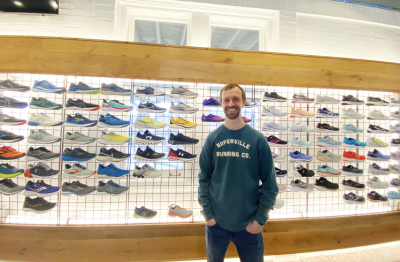
Naperville Running Company
Time for a Change
After 26 years of using the same point of sale system, Naperville Running Co. finally decided that it was time for a change. The company switched from Microsoft RMS to Lightspeed POS earlier this year.
One of the biggest reasons for making the change was the need to upgrade the store’s operations, including how they manage inventory to be cloud based. Kyle Brady, director of retail and store management, says that it had become expensive to hire IT professionals to upload a new POS for a register or a backroom computer when needed. The existing system also did not have a loyalty program for customers.
The switch to Lightspeed has allowed other operations and programs, such as e-commerce to run more efficiently and it allowed for the company to introduce a much-needed new loyalty rewards program.
“We’re able to communicate with our customers a lot more frequently and more targeted with that, which is nice,” Brady tells Running Insight. “And then like some of the reporting things are good.”
Brady says that the transition hasn’t been a difficult one for customers who shop at the store.
“From the customer side of things, it’s been good,” he reports. “It’s been really smooth, which is nice.”
Brady’s biggest advice to others looking to up their technology game is simple: As technology evolves, put more time into making things work correctly and properly for the good of the company.
“Whether it’s like Optio or other analytics programs, I think that there’s a kind of ‘sky’s the limit’ to all this stuff,” Brady says. “It’s super important to make sure you’re staying on top of everything.”
Track Shack
Keeping It Simple
Sometimes it’s the simple things that make the biggest difference. This is the case when it comes to Track Shack in Orlando, FL.
The storied company has been in business for almost 50 years and Chris Hughes, VP–business operations, describes the company as old school, mentioning that the store didn’t sell products online prior to the COVID-19 pandemic in 2020.
The one thing that the store added that has made a huge difference is a digital queue that customers use to sign in when they arrive at the store for a shoe fitting. The queue will notify customers via text when there is a longer wait time.
Hughes says that the digital addition has given customers more flexibility to decide if they’d like to stay on site, or venture around the area near the store while waiting. It’s also shored up little things, such as the messiness of people’s handwriting, which eliminates confusion.
“Just digitizing that, believe it or not, has been huge for us,” Hughes adds.
The digital queue offers a section for outfitters to write specific notes based on the needs of the customers, allowing them to streamline fits, while making the process more efficient.
“So if they’re dealing with a specific injury, if they have to fit to a certain type of orthotic, if there’s parameters from podiatrists of what they need in the shoe, even if they want to select an individual salesperson to work with, they’re able to notate all of that in the comments on the iPad,” Hughes explains.
Hughes advice for other retailers, especially those who have been around for a long period of time is simple: Don’t be afraid of change.
“If you’re consistently profitable and you have systems that work, sometimes it’s easy to think that you don’t need whatever is new on the block,” Hughes points out. “But for some of those simple uses, you can save time and use that time and energy towards other things more efficiently, more effectively, by just being open to new stuff.”
For the Run
Welcome AI
As the founder and owner of For the Run, the online running apparel store that was launched in 2019, Shawn King knows that operating a small business requires great precision, especially for someone like him who is involved in all aspects of the business. One of the things that helps King stay afloat is Artificial Intelligence.
King made the decision in 2023 to move to AI after years of employing the Search Engine Optimization model for his business. King says the move has saved him at least 20 hours a week and has made his business more efficient.
“Through AI, I’m able to really have an impact on every different part of the process, from development of apparel or stickers, all the way up to trends and dates and windows that make sense for things to drop,” King explains.
King says AI also helps assist with backend tasks, such as inventory, managing SKUs and tracking orders. It also gives him a peek behind the curtain to see what other brands are doing well, as well as trends that are taking place throughout the running community. This allows for him to properly strategize his next steps for the business.
“It just helps with forecasting, it helps with planning, it helps with understanding how successful a drop or a single release of something was, and just kind of helps me stay on my toes a lot better.”
King believes that retailers looking to implement AI into their business model should never lose sight of the audience and the community that they are serving.
“Know your market, know your user, know your runner and never lose sight of what you want your shop to be doing,” King says.
Fleet Feet Tuscaloosa
Do It Yourself
If you want something done the right way, sometimes it’s best to create it yourself. That’s what owner Henry Carpenter and the team at Fleet Feet Tuscaloosa did.
“Stride is our in-house inventory and business dashboard,” Carpenter explains. “It has role-based views, so the owner, finance, marketing, a floor lead and an outfitter each see what they need and nothing they do not.”
The model allows invoices to route straight into QuickBooks instead of getting keyed in by hand. Carpenter says it also allows for the staff to scale model stocks up and down with the season instead of ordering off of gut feel and it allows them to swap proposals and move slow styles out before they turn into dead inventory.
Fleet Feet Tuscaloosa has been in business for four years and, according to Carpenter, investing in technology played a part in the store’s success.
“We opened in September, 2022 with a small team, so technology was the only way to punch above our headcount,” Carpenter says. “We have won the Best Running Store award two years running and year two came with a different leadership team, different outfitting staff and a new location. That only happens if the systems hold the knowledge instead of individual people holding it.”
Madison Sanschagrin, marketing director at Fleet Feet Tuscaloosa, adds that the innovative technology helps her to serve the community, strengthen the business and help her team grow. She believes retailers shouldn’t limit themselves on how technology can not only help business, but community growth.
“Think outside the box and look for ways to adapt in every part of your business,” Sanschagrin says. “The goal isn’t to use technology just because it’s new. It’s to use it to create a better experience for your customers, strengthen your team and build a stronger community.