W
hen Beth Salinger took over Run Madtown as owner and race director, she knew she would need to leverage her marketing expertise to bring new life into the half marathon, 10K and 5K.
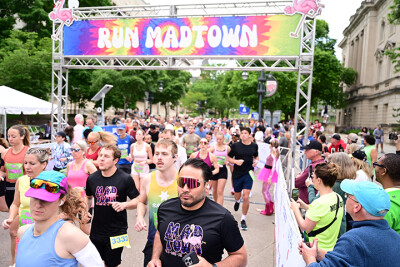
The annual Memorial Day weekend event in Madison, WI, started as a marathon more than 30 years ago. The organization scaled down its race distances over the years and paused entirely during the COVID-19 pandemic. When the race returned in 2022 with a fraction of its participants, the owners decided to sell it.
Salinger came into the position with extensive experience helping race directors grow their events as founder of Endurance Marketing and owner and race director of Fort2Base.
To revive Run Madtown, share its story, and disseminate information to race participants and the community, Salinger saw an opportunity for an initiative she’s produced in the past: a digital race weekend magazine.
The goody bag/race magazine debate
“I’ve been working in the industry for over 25 years and, really, there’s always an issue with participants finding information,” Salinger shares. “So, I’ve done magazines of some sort, or general race weekend information, for probably the last 15-plus years.”
Race magazines are most often associated with major marathons. The Boston Marathon has its Official Program, a printed magazine-style booklet that’s handed out at bib pickup. And the London, New York City and Chicago marathons each have magazine-style digital race guides.
But, according to Salinger, there’s also a place for race weekend magazines at smaller events and she believes they’re more functional than the status quo physical and virtual goody bags.
Regarding physical goody bags, Salinger shares, “I stopped doing them years ago because most of the people throw out 90 percent of the stuff in it and it’s really not environmentally friendly.”
Virtual goody bags, which grew in popularity in the 2010s, eliminated the costs of materials and the time it takes to stuff thousands of physical bags. When delivered via email, race directors can track open rate metrics to share with race sponsors.
The problem, Salinger says, “A lot of people don’t really care about those, because there’s really nothing that forces them to go into the goody bag.”
A digital magazine, however, includes race weekend information people need: where to park, what time the race starts, road closures, course maps, athlete tracking details, age-group breakdowns and more.
“That’s why we see people go in multiple times,” Salinger says. Run Madtown had just over 3400 participants in 2026 and the race weekend magazine was opened 4200 times with an average read time of just under five minutes.
While distributing race weekend information to participants, spectators and community members is the primary objective, the resulting performance metrics are of value to sponsors.
“We can say we put this magazine out this many times, people have opened it this many times, your link was clicked this many, so that is really nice,” Salinger says.
Creating a digital narrative
In true magazine style, the race’s culture is captured on the pages throughout Run Madtown Race Weekend Magazine, from a feature article on the race organization’s Equity in Motion Scholarship to a race ambassador profile.
“We feel like we constantly need to be telling our stories so that people understand the history and where we’re coming from and why we do certain things the way we do,” Salinger shares.
When Salinger took over Run Madtown, everything changed: the logo, the courses, the start and finish lines. In 2026, 53 percent of participants were first-timers at Run Madtown.
Sharing stories about the race’s history and current initiatives helps to create more engagement and excitement for participants going into race day. Among stories, Salinger shares: “Who made our course maps and why is that important? Why don’t we use the word ‘runner,’ and why is that important?”
But storytelling is worthwhile for every race, not only those that are new or rebranded.
“A lot of races are hitting 50 years right around now,” Salinger notes. “You need to tell the story of the history of your event. There’s a lot of newer people coming into running.”
While social media channels can help amplify or add a video element to these stories, the magazine features provide the fodder.
Pulling it all together
Perhaps the biggest barrier to transitioning from a goody bag to a race magazine is the team needed to put it all together. Magazine writing, editing and layout and design require more dedicated hands and professional expertise than an afternoon with a room full of volunteers stuffing goody bags with provided materials.
Salinger works with a student-run organization at the University of Wisconsin-Madison, called Wisconsin Marketing Organization, to develop Run Madtown Race Weekend Magazine.
Stories are decided in the fall and written over winter break. Salinger writes the “guts” of the magazine, which includes the race weekend participant and spectator information. Race sponsors create and submit their ads by a pre-determined deadline.
“For the past two years, for ’25 and ’26, we actually had an intern that put together the whole magazine. She did all the layout,” Salinger says. “It’s nice that when you’re doing this internship that you have something concrete that you can then take and say, ‘Hey, this is a true example of something I’ve worked on.’”
The team has several sets of eyes on the magazine to catch typos and errors and Salinger makes final adjustments to the information, ad placements and photo decisions. Just in case a page needs to be updated with accurate information if details change after the magazine is published, each page is created separately.
It’s a lot to pull together, but the feedback is positive. In this year’s post-event participant survey, the magazine was rated 4.5 out of five.
Five Tips on Developing a Race Magazine
Reflecting on her experience and what’s worked best in the magazine development process, Beth Salinger shares these five tips for race directors and run retailers interested in launching their own race weekend magazine:
1.
Have
a
second
set
of
eyes to proofread the magazine. In fact, the more eyes, the better.
2.
Use
the
technology
you’re
comfortable
with, whether that’s InDesign, Canva or another program that allows you to build a magazine.
3.
Every
race
has
a
different
look
and
feel. Identify your race’s culture and style and build your magazine to reflect it.
4.
You
won’t
be
able
to
do
everything
at
once. Start simple in Year One and expand the magazine as you establish your process and build out your team.
5.
Don’t
be
afraid
to
think
outside
the
box. In the most recent Run
Madtown Race
Weekend
Magazine, Salinger’s team added a flamingo coloring page that one of her interns created with the help of AI — a flamingo is Run Madtown’s mascot. Salinger says, “That was super fun and super different, and I loved it.”