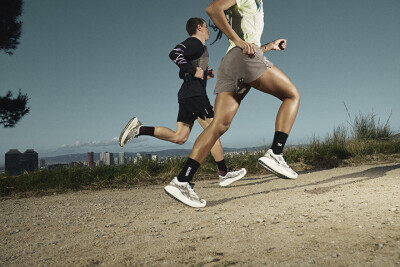
If there’s a market that’s ripe for a gravel shoe category, Flagstaff, AZ, is probably it. With dozens of miles of paved and gravel trails running in and around the city, having an all-purpose hybrid shoe that’s suitable for multiple surfaces can be appealing. James Wilder, the manager of the Run Flagstaff shoe store, says it is, and gravel shoes are flying off his shoe wall.
“Given the terrain here, and the accessibility to urban trails, a gravel shoe makes sense,” Wilder tells Running Insight. “We have some models we can’t keep in stock.”
Created and marketed by many shoe brands – Diadora, Hoka, Salomon and popular newcomer Mount to Coast, among them – gravel shoes aim to hit that sweet spot between a lightweight, speedy road shoe and an aggressive, heavy-hitting trail shoe. They provide versatility to runners who like an all-purpose shoe for multiple types of terrain and do it all efficiently.
The shoes themselves, then, include some of the popular lightweight energy of today’s road performance shoes, along with a bit of grip in the form of pared down lugs from a traditional trail shoe. As with any category, each brand will highlight different standout features, but all are targeting that hybrid runner who likes to mix it up, or the runner who spends a good deal of time covering pea or crushed gravel trails popular in many parts of the country.
Not everyone believes the category is a necessity, however, and some say that brands have created a marketing term. “It’s not really solving a problem,” points out Kevin Fallon, co-founder at Speedland. “Gravel surfaces aren’t a road or a trail, so you could wear either and be just fine.”
The jury may still be out on whether gravel shoes will become a mainstay on the shoe wall, but in the meantime they’re selling well and worth a retailer’s look.
Anatomy of a gravel shoe
Hong Kong-based Mount to Coast added its gravel shoe – the H1 – in 2024. “We had our head of product in the U.S. and took him running in Boulder and California,” says Doug Rosenberg, the U.S. country manager. “He noticed that the trails were less technical than in Europe and that, in response, there could be a need for a shoe with less aggressive lugs that could also be more runnable on gravel or dirt surfaces.”
The company went to work designing the H1 and today it’s one of its best sellers. The differentiator is its outsole, says Rosenberg, which clocks in with 2mm lugs that essentially “disappear” on the road, giving it a high level of versatility. “When you take a standard trail shoe on the road, you’re going to feel the lugs,” he says. “With this shoe, you don’t know they’re there.”
To allow for improved grip for gravel and light-duty trail surfaces, Mount to Coast uses a proprietary material it calls “VersaGrip,” which provides the stickiness runners need to feel confident. The midsole consists of organic waste and biomass, making it not only sustainable, but lightweight and capable of energy return. “The combination of the outsole and the midsole makes it fun and bouncy,” says Rosenberg.
Italian-based Diadora, likewise, saw a need for a different category of running shoe, creating their Nucleo 2 GR model for runners looking for versatility. Gelindo Bordin, director of sport and marketing (and Italy’s first Olympic marathon gold medalist), says the shoes are particularly popular in France.
“There’s a consumer there that looks for a shoe that can move back and forth from asphalt to gravel and sometimes even grass,” he says. “We wanted to make a shoe that allows them to move comfortably from one to the other.”
While the U.S. market hasn’t been as demanding for the model yet, it’s catching on, says Bordin. Because of its unique qualities, Diadora sells the shoe largely in run specialty stores, with a small DTC market. “The stores can explain the product to the consumer,” he says, “and that can get lost in direct-to-consumer.”
Salomon’s Erin Cooper, North American senior marketing manager, performance + sportstyle, says that the brand’s Aero Glide 4 GRVL model is a perfect companion for runners new to the trails.
“It provides the comfortable, lightweight silhouette and underfoot feel of their daily trainers with enough grip and traction to be confident on light trails, rolling hills, gravel paths or any other non-technical mountain terrain,” she says. The Aero Glide combines a mid-foam comparable to the brand’s road shoe and the Contragrip outsole rubber compound, matched with 3.5 mm lugs.
While Speedland hasn’t created a shoe they market as a gravel shoe, Fallon says that its RX:LDVL model features a 3.5 mm lug, which fits the bill. Its GS:BLK model has an aggressive lug profile at 6.5 mm, but users can trim them down as wanted, as well. “It’s tech we took from mountain biking and applied to shoes,” Fallon says.
Speedland’s approach to gravel – or official lack thereof – and its sales channels differ from most other brands. “We have been selling about 80 percent through DTC,” says Fallon, “but we’ve been increasingly moving into stores as well. If you have a good sales staff who understands the technology, run specialty can be a good channel.”
At Run Flagstaff, consumers can find several gravel models from which to choose. “We have a pretty even split between road and trail and we position gravel on our trail wall,” Wilder says. “But gravel shoes have performed well since the beginning.”
There’s a case to be made that gravel shoes will perform better in certain regions of the country, especially those with a high prevalence of crushed gravel or packed dirt trails. But brands that have entered the category remain bullish on its future.
“It’s only going to grow,” says Rosenberg. “On the one hand you have the hard-core runners who want a full quiver of shoe options. On the other, you’ve got the runners who want the do-it-all shoe. Gravel fits in with both.”
Cooper concurs: “The traction is real,” she says. “To have an option that works across multi-terrains enables runners to have a great go-to option for every day, if that’s what they desire.”