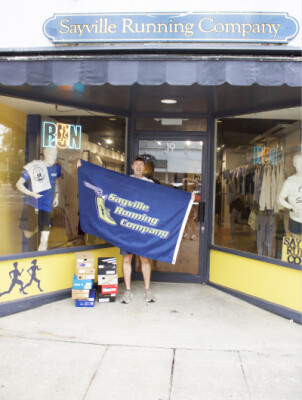
Saturday, August 15 was a big day for Brendan Barrett and his team at Sayville Running Company. After nearly two years away from their commercial home in historic downtown Sayville, NY, due to damage from an October 2024 fire, the 20-year-old running shop returned to 19 Main Street and welcomed customers back into its storefront.
“There was a lot more relief than I realized, especially after a good day of sales on Saturday,” says Barrett, who co-founded Sayville Running Company (SRC) in 2006 alongside Michael Nolan. “I really felt the weight off my shoulders.”
The previous 22 months delivered a slew of challenges and uncertainty, but also provided Barrett something he didn’t expect to gain from such an unfortunate experience — fresh perspective and heightened optimism for the future.
‘Nothing you can really do’
Barrett was on a ferry heading to a former staffer’s wedding on the evening of Friday, October 25, when he received a cryptic text from his brother-in-law asking if everything was okay. Minutes later, Barrett began receiving a slew of text messages from others as news of a fire on Sayville’s Main Street spread. Barrett was soon on a video call with an SRC staff member – the store was closed when the fire erupted at a former restaurant space three doors down from SRC just before 6 p.m. – and able to observe the chaotic scene with his own eyes.
“Not a good feeling,” he recalls.
When the ferry reached land, Barrett immediately reversed course and returned to Sayville. When he arrived in downtown Sayville around 8 p.m., firefighters were still working to extinguish the blaze.
“It’s a helpless feeling because there’s nothing you can really do,” he says.
When Barrett was finally able to walk the property the following morning, his heart sank. The roof on the two-story property was gone. The pungent smell of smoke overwhelmed the air. Water was everywhere.
“It looked like a swimming pool was dumped on our building,” Barrett recalls.
While some storage racks, fixtures and timing equipment were salvageable, everything else was lost, including inventory. Though admittedly difficult, Barrett embraced an optimistic outlook. No one was hurt, the business held insurance and SRC had proven itself a resilient business able to withstand unexpected punches before, namely the COVID-19 pandemic.
“I thought, ‘We’ll figure this out and be back in a few months,’” Barrett says.
Allies tried to temper Barrett’s optimism, fearing bureaucratic hurdles and navigating insurance alone could push SRC’s return well over one year.
“As it turns out, even those ‘realistic’ estimates were too low,” Barrett says.
Following the fire, Barrett received texts and phone calls from friends across the run specialty world, including fellow retailers offering their support, from product to fixtures to advice. Local retailers in Sayville reached out as well, including a hardware store that offered to carve out space in its storefront for an SRC pop-up. A group of customers, meanwhile, launched a GoFundMe page. Within a week, the online fundraiser topped its $10,000 goal.
“I felt overwhelmed at times,” admits Barrett, a native Sayvillian who helped lead Sayville High to the state cross-country title in 2000.
Determined to move forward, Barrett began contacting his vendor reps, who he called “gracious and accommodating,” before working with vendors’ credit departments to plot a path forward. Barrett says SRC’s 18-year track record of paying bills on time coupled with some earnest humanity from vendor partners steadied conversations and unlocked compromises.
“We had business interruption insurance, but only for a year. Plus, it’s not like insurance checks arrive overnight,” Barrett says. “We needed some understanding and, fortunately, our vendors worked with us.”
Within a month of the fire, SRC also landed a temporary space just over a half mile away from its Main Street home. The landlord, a fellow Sayville small business owner, offered fair rent and a month-to-month agreement for the rough warehouse space, which Barrett and his team converted into a makeshift retail shop. Though SRC’s monthly sales volume in the temporary storefront registered 20-35 percent lower than its Main Street location, the revenue nevertheless allowed Barrett to maintain staffing.
“Keeping everyone together was one of our top priorities,” says Barrett, who also operates a sister store, Smithtown Running Company, located about 12 miles north of SRC.
Though Barrett hoped for a swift return to Main Street, SRC’s homecoming encountered various obstacles that pushed the timeline closer to two years. The unexpected death of SRC’s downtown landlord – a fair and professional partner with working knowledge of permits and the local commercial landscape – brought the rebuilding project at 19 Main Street to a standstill. Yet more, bureaucratic processes contributed to further delays.
“It was no one’s fault,” Barrett says. “It just is what it is.”
The silver linings
On Thursday, August 13, about 30 friends, including current and former staffers, assembled at SRC’s temporary home to facilitate the shop’s return to Main Street. After a day-and-a-half of moving, organizing and merchandising, SRC was recording sales by Friday afternoon.
“It’s exciting and fun being back on Main Street, where you can easily bump into people you don’t see when you’re off the beaten path like we were for two years,” Barrett says.
While the previous 22 months featured undeniable trials and consistent tests of faith, Barrett believes SRC has emerged from the ashes a stronger operation.
“We’ve mastered things in a way we hadn’t before,” he says.
With slimmer funds and space than usual at the temporary space, for instance, Barrett sharpened his purchasing practices. He studied his sales numbers at a more intense rate than any other time in SRC’s history and fortified his processes for buying inventory.
“This will make hard decisions down the line that much easier,” Barrett says.
As he prepared for SRC’s Main Street summer homecoming, Barrett also spent time with staff reimagining the new storefront. He revisited notes from The Running Event about merchandising, read Running Insight stories about store design and watched videos from 3 Dots Design to inform SRC’s eventual look.
The new SRC reflects this intentional work. The store features modular displays instead of slatwall, a custom shoe wall constructed of industrial piping and wood, wall signage to signal product categories and light cream walls that enable product to pop. Barrett also moved the cash wrap to improve flow and open up “primo space” for merchandise.
“It still feels like us, but is definitely a little more professional,” Barrett says of SRC’s new digs. “It’s just great to be back home.”